Introduction
This text investigates the aesthetic and ontological dimensions of non-idiomatic improvisation by bridging performance practice with the philosophy of Gilles Deleuze and Félix Guattari. To ground this theoretical framework within contemporary artistic research, the paper analyzes extensive documentation from a landmark workshop on non-idiomatic improvisation led by Tristan Honsinger[1] in 2013, hosted jointly by the Royal Academy of Art (KABK) and the Royal Conservatoire in The Hague (NDL).
Free or freely improvised music. Total improvisation. Open Improvisation. Free Music. Improvised Music. Non–idiomatic improvisation. Radical Improvisation. Experimental improvisation. Extemporary composition. Hetero-directed improvisation. Creative music or creative improvisation. I used the term “non-idiomatic” improvisation clearly referring to Derek Bailey’s words.[2] Although I don’t entirely understand his conception when he brings back the non-idiomatic within the “free” improvisation. However as I will further try to clarify better, my aim here is not to search the “right” term. Indeed I chose “non-idiomatic” because I think these word containing the negation a concept, give emphasis to the value of the multiplicity of the practice it describes. “Non-idiomatic” improvisation has its own richness from the variety of traditions (historical and personal ones) that it belongs to. It “also” belongs to, but never “just” belongs to: “The characteristics of freely improvised music are established only by the sonic-musical identity of the person or persons playing it”.[3]
This text has been revised and expanded for the release of my first solo album, which represents the culmination of my musical research to date. Numerous workshops on non-idiomatic improvisation, alongside historical and musico-philosophical inquiries, have been instrumental in defining both the conceptual framework and the pragmatic approach of this research.
This material is published with the intention of fostering critical reflection on music – and, by extension, on existence – among skeptics and proponents alike.
I express my sincere gratitude to Dr. Stefano Marino for his invaluable contribution during the proofreading and revision phases of this text.
“Improvisation is always changing and adjusting, never fixed, too elusive for analysis and precise description; essentially anti-academic. And, more than that, any attempt to describe improvisation must be, in some respect, a misrepresentation, for there is something central to the spirit of voluntary improvisation which is opposed to the aims and contradicts the idea of documentation”
Derek Bailey, 1980
The Process
Den Haag, 02/2-3-4/2012, Non-Idiomatic Improvisation in a music ensemble: Tristan Honsinger workshop documentation
“Breathing is reflection,
Reflection is feeling nothing,
Nothing is the bridge to movement,
Movement is a measurement of space,
Space is before and beyond conception,
Conception instigates breathing”.
Tristan Honsinger[4]
Note: All the materials collected in these pages are faithful (as far as it can be) transcriptions of some reflection of Tristan Honsinger recorded during a three-day workshop at the Studio Looos in Den Haag (NDL) with first-year students of the Master in Artistic Research (MAR).
“Aesthetic toward Practice”
Get Rid of Automatism
What I am trying to do is to get rid of absolutely all automatism, so realize that when you stop than it seems to be over and than you… you let the space, you give the time… become nothing… something happens, no! I don’t that before… no… Hepp! Errrh! Beginning! Without… just… ok…
You Infect Yourself
It seems like you infect yourself. I think the thing is, is that, ok you have a gest [5] and it comes from within and than it seems to… there is no break… the… somehow there is no stop, it seems like the “no – stopmation” you get into a kind of process where there is no possibility for transparency, for fragility and for… the possibility to be absolutely nothing… which means stop! (long silence).
Time can be Intransigent. Silent is the Measurement
[…] but time can be intransigent… does everybody understand “intransigent” (silence) … mhmh ok… well like a mountain: it appears not be moving, so it’s “intransigent”, it doesn’t really move… because we are going at another speed and somehow, we.. uhm… I think we’re communicating which is basically a misunderstandable… it’s a… what I say to you and what you say to me might be a totally misunderstandable… but we seem in any case vibrate… and so we don’t particularly have to react to one another, thinking about the “intransigent” sometimes. So basically, we’re trying to slow the all thing in two different time/space. (silence) What I would like to do now is to do, just two people, thinking about that: not reacting at all to the other person, that… you basically try to observe what’s your rhythmic before you go […] So you kind of don’t choose to do something until you have forgotten why you wanted to react in first place. Let’s just try… you and you… do something… and please try to… make your gest out of nothing… and… eheh… just do it! And… you try to go inside and than… ja… and don’t worry about the silent, the silent is the measurement of your gest, think of yourself in different rules.
Surprise yourself
It’s kind of like, I like to say this to everyone, It’s kind of like try to surprise yourselves when you do something and don’t have… ehm… as, as much… ehm… don’t feel any tension when you’re not doing something, when… just… maybe it is about breathing, maybe we have to insert this in the thing, trying not forget our breathing…
“Strategies”
Articulating the Ensemble
Let’s try a kind of play with everyone but yourself of trios, so… one trio begins and than one trio takes over… and than the next takes over, takes over, so it is an exchange of trio.
Tell me about your Process
Tristan – Leo I want to ask you if you could explain a little bit, because it was very interesting what you were doing at the end, kind taking small pauses, could you
explain the process that you went into…
Leo Svirsky – I felt like, I felt like the piece was, it was very episodic, so it was… so it’s like we do one thing they do one thing and everything is kind of short so I wanted to have an idea going on for a bitter longer but also one with still involved silences so the idea was… yes, was something that plays on this things but goes longer so it’s a longer idea that still has opening side…
Tristan – Ja was interesting in the open because they were quite effective… eheh…
Silence very much Slowness
And this is… how can I explain it, we being doing this all day, we are actually working with silent, trying to bring it back to some other time… I will say the time of that…(the time) is going extremely slowly, so we can use silent very much, trying to create, yes… some kind of… we find out our own slowness, everyone finds their own slowness. What I actually mean is also how your mind perceives this slowness and how you can associate from one, from one “piano”(plateau), one level, to another level, to another level… in respect of time and the space of course. Space is so vast and time is not moving.
All Invent a Story
Tristan – I was thinking that we could all invent a story, now I am going to go a little bit quick. Each person makes a story out… you don’t have to… it’s for you, your own use… and that… for instance, when the table comes on we can start a kind of process, everyone under own story, but the only thing is that the story has places… for example the cow was walking down on the road and she meets up at the telephone booth… the telephone booth is something that… is a place, and you have a market, you have… you have in front of a statue a certain … certain places and everyone can use one of these places in their story. And so when your story intersects with a particular place you play there. So it’s kind of like going through the story and ends up in one of these places that all let’s have in common… and… that’s were we encounter different stories. This is like I am really shooting in the dark, I never done this before, but… so… ok… we have to have five different places. So let’s choose five different places…
Chris Iemulo – the river…
Tristan – … river… ok…
Janneke Van der Putten – desert…
Tristan – … desert… gasoline station…
Aline Weyel – …roof…
Tristan – …roof…another one…
Jessica Sligter – … phone booth…
Tristan – … so… ok… everyone… in their (our) story they (we) choose two of these five elements, everyone, so the story goes through the river… tatatatà… and goes to the gasoline station and those are the only two that you choose… and others choose others…
Using Fragments #1
So… ok this one is for everyone, what we do it’s in three fragments as well, so we choose let’s say… I am part of the first fragment, you can be part of one or more fragments, for the all ensemble, as well as you can… you can use your voice, you can say something that is just a small fragment […] So everyone of these (fragments) call another group of improvisation, so for instance the all thing, the large, the ensemble fragment calls… Janneke and Renato duo… the… your fragment calls Jessica and Doris another duo… and… the first fragment calls the last duo…
Using Fragments #2
Tristan – … in between these fragments… so let’s say fragment one calls solo, fragment two calls duo and fragment three calls solo…
Janneke Van der Putten – or “tutti”?
Tristan – no the “tutti” calls a duo… the third fragment calls a solo…no? yes…
Leo Svirsky – at the instruments?
Tristan – Yes…
Leo Svirsky – Ok… so which fragment is which?
Chris Iemulo – Let’s repeat it again…
Tristan – Let’s repeat it… I have the first… yes I am the first: ah-Ah-ah-Ah… than you…
Christian Ferliano – (making unintelligible verses)
Tristan – … yes this one, that’s the solo (sign)… the duo (sign) is the one (fragment) with all of us…
Christian Ferliano – the trio of you is just one fragment…
Janneke Van der Putten & Leo Svirsky – …aaahh! ok… (Leo) so there is one fragment that cues the solo and than… so there are only two fragments…
Tristan & Christian Ferliano – … nonono there are three…
Leo Svirsky – … oh nono sorry… so the two fragments or… the first fragment is a solo, the second fragment is a duo and the “tutti” is solo…[6]
Tristan – … yes!
“Metrical Strategies: Words as Sounds”
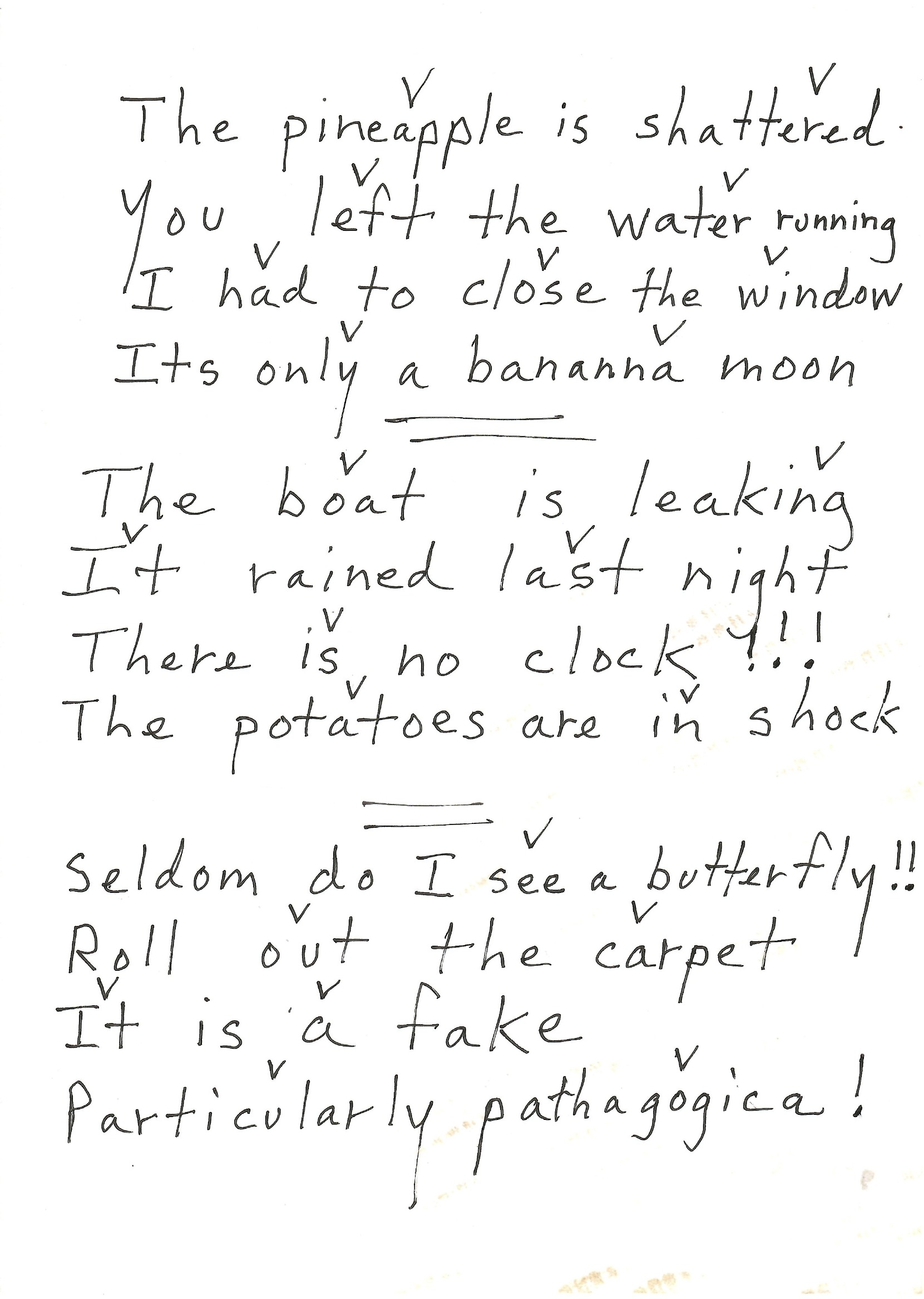
Tristan – It is important that…you make the syllables clear for us… you can do it how do you want, when you want but that we are playing these syllables in time. So “the pineapple” is the… this is how we can do it: I’ll take “the pineapple is shattered” and “I had to close the window”, right, I’ll do those two… Leo you play “you left the water run”.. so when you hear “left” will be the accent and “wa-ter” is the other accent, and you take also “it’s only a banana moon”… we have to catch the accent as near as possible… and you (Chris Iemulo) play two, you can play “you left the water run” and “I had to close the window”…ya… so… let’s try it.
“Toward a Graphic Score Strategy”
Tristan – We have to… when you begin the long tone, we try to do it as an ensemble, starting all together…
Janneke van der Putten – How do we start all together?
Tristan – That’s a question…
Leo Svirsky – I think if you keep it as long as you have breathe…
Tristan – … yes it’s good, we can give a look when he starts… duuuu… that’s a good idea Leo we’ll follow you… maybe I don’t know… we can write this down…
Let’s write it down #1
Tristan – I would like it: aeeeeeee-hi… aeeeeeeeeeeeee–hi-hi…
Janneke Van der Putten – the same having the chaos? Like yesterday
Tristan – also… like… both…
Let’s write it down #2
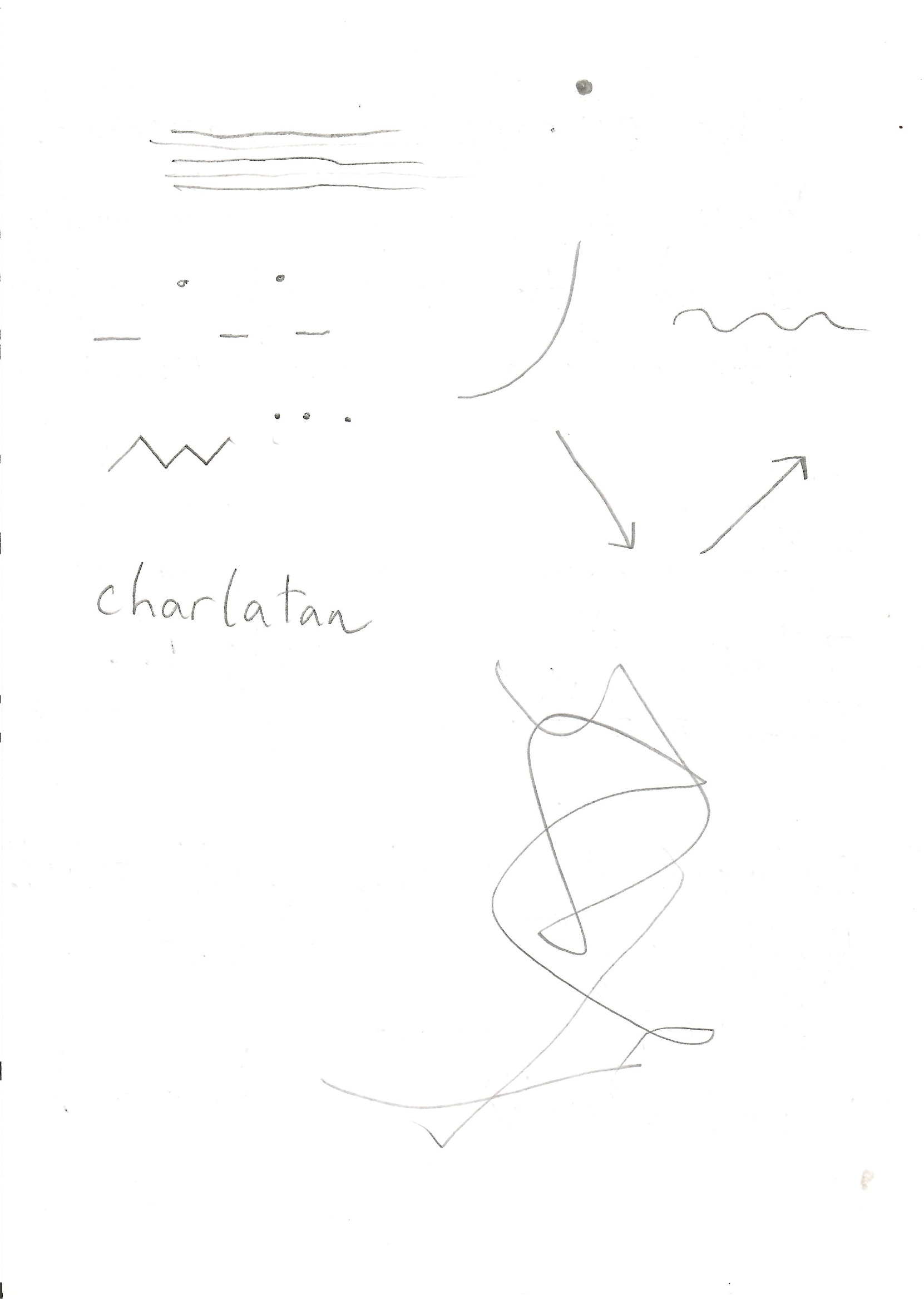
(Tristan showing the graphic score he draws, talking with Janneke)
…“Charlatan”… so let’s… at this point: eeeeeeeeeee-hi.. eeeeeeeeeeee-o-pi-o-pi-ooo….. eeeeee..oiii… oiiiiiiii-oeia-oeia-oeia-oeia… ieeee.. o-hi-o-hi-o-hi… ehp-eh-eh… iiiiuuuu… uuuuuiiii… “Charlatan”!
“Working on the performance for a No – Structure”
How to use the materials
Tristan – I think there is just one think I want to say, that there can be a lot of jumping from one thing to another. It would be good sometimes to stay on one thing for a little bit longer, like also the pieces, the musical pieces that of course is possible, but it also means the “word” things and the this piece for instance… I would also like to kind of see that we can do simultaneous things… like, for instance you… you… we can play this piece “pàbipà-pipo-pipo-pii” (referring to the melody of his piece we were playing together) when you and I talk about the leaking boat… or yes, using these text… so trying to combine all the materials we are going to use… so any… you want to do this piece with the rests?
Chris Iemulo – Nono, this is good
Tristan – Yes, this is good
Janneke van der Putten – Sometimes is it ok to do more ends?
Tristan – Ends?
Janneke van der Putten – Well like, sometimes it was like one thing and than… like can one person do more ends after the long tones or we just choose one and than we go back…
Tristan – Yes, you just choose one of these, just one, not two at the same times, not in sequence, just remain on the one that you choose and also occurs to me that it’s when actually you do this things that kind of makes the variation…
Janneke van der Putten – and than, when someone says the word (“Charlatan”) like all start to improvise sometimes, that’s also… I didn’t…
Tristan – Yes… maybe we should just use “Charlatan” and… maybe two words…
Chris Iemulo – but also just “Charlatan” … I was just thinking about the improvisation, what Janneke says. Sometimes we are reacting immediately, like someone says the word and vum! the improvisation… so maybe we can also do like “Charlatan” and than starting from…
Tristan – Yes, yes, starting from… we should always be keeping in mind what I was talking about the first day, about trying to get… not make the first choice, no reaction, go to the forth association…
Janneke van der Putten – So when someone says “Charlatan” actually is that we can all improvise…
Tristan – Yes… but it was also nice that occurred of very short improvisation.
The Walking Game and Strategy to Conduct
So this game we can try, let’s try it now… so this is two duos at once (Tristan scratch his head). This is a duo (Tristan sat down crosses his legs ). This is stop (Tristan taking off his hat). That’s it… as well as when someone stand up, silence… this can be done by everybody…
“The Process in the happening of the Performance”
This performance is a three days process, some kind of research into how we can stretch our time and delineate out of time. I’ll say like that.[7]
“The Process”, Tristan Honsinger, cello, Janneke van der Putten, voice, Chris Iemulo, cl.guitar and the guests Leo Svirsky, piano, Christian Ferlaino, saxophone
The presentation-concert took place on the evening of April 4 2012, at the StudioLoos in Den Haag, The Netherlands.[8]
PART II
Towards an Aesthetic of a Practice
What-is
At the beginning was Parmenides (515 a.C. – 450 a.C.): what is, is. What is not, is not.
What is (in Italian “l’essere” literary “being”) is one, fixed and immutable, timeless, necessary and uniform, existent. But there is a world of appearances that follows the “path of opinions”, domain of sensory faculties, which lead us to false ideas, deceitful concepts.
Plato was deeply influenced by this thought and, consequently, all subsequent Western philosophy has been influenced by it.
If the reality is fixed and immutable then the concept of “becoming”, of what is in the middle, becomes a big problem.
Western metaphysics, searching for the eternal truth of all things, focused its attention on their supposed immutable side: the “essence”, what is unchanging. It is Plato’s horse[9] who can be black, white, small or big, dead or alive, working in a field or riding in a hunt, and it is still the same horse: it doesn’t change in its essence. So in short there is a Horse and an horse. This last one, the one we can see and touch and ride and eat is part of a “lowest” reality[10].
This idea of what-is as a non-material abstract forms that is given to our knowledge as a visible object, leads to a kind of reassuring gaze on the reality, because of the reassuring character of the identification of what -is with the unchanging. But what happens if we apply this concept extensively to our life?
To say that “what -is” cannot “become” (other) means that it is not subjected to any hope, fears, shame, and it appear very close to a kind of objectivity. This view to the eye of Nietzsche and later Heidegger, sounds as the music, the soundtrack of the “totally organized working society” to which is opposed a new concept of “what -is”, unthinkable as a purely given objectivity. A new consideration for the potentiality within reality and the human being. “Transcendental is Dead”.
Differences of words specularity of Thoughts
Non-Idiomatic Improvisation as a Rhizometic Practice
“[…] There exists a nomadic absolute, as a local integration moving from part to part and constituting smooth space in an infinite succession of linkages in direction.
It is an absolute that is one with becoming itself, with process.
It is the absolute of passage”.
(Gilles Deleuze)
Deleuze’s figure of the nomad is a non–idiomatic improviser[11]. Deleuze speaks about the “nomadic joy of the improviser who enacts before our eyes the predicament of preservation and destruction experienced by all art.”[12]Where to improvise means joining, or even melding with, the World: “[…] One ventures from home on the thread of a tune. Along sonorous, gestural, motor lines that mark the customary path of a child and graft themselves onto or begin to bud “lines of drift” with different loops, knots, speeds, movements, gestures and sonorities.”[13]
When there is no score coordinating the musicians playing together, they can just belong one to each other: hearing each other, talking each other, trying to supply the absence of an over-central pre-ordinate central unity by creating a mobile web of relationship and correspondences from one to another. The same process happens when one is improvising alone: we will be engaged with our multiplicity, with the others we are. Improvising, “to do a rhizome”, to get into the immanent activity of “building and destroying”. Dealing with the experimentation of the past in the moment that it becomes the present in a “futuristic” version.
To experiment is the verb that declines the future in the field of non-idiomatic improvisation (hereafter cited as n.i.i.).
N.i.i. is a map of points turning into lines in a liquefied, energetic, transparent and fragile chaos created and re-created through the constant interaction between the musicians: it is comparable to a singing bird in a wood that throws filaments of sounds from one branch to another in a web of correspondences that are not structurally reducible. The bird could not live without deterritorializing himself/herself through his/her chant. To improvise is the capacity to create thick internal correspondences before and behind the external one. Identities that are “non-identical”, fractured and dialogical. The “conference of the birds” and the “rhizome” that otherwise could be turned into an autistic ritual of codified correspondences between the musicians on the stage. This is the risk. A risk that has to be taken. The inevitable responsibility taken by the n.i.i. improviser is that of becoming a nomad: through his/her own histories of the music, walking with small, fragile strong steps, ready to fall and get back, and then again and again, but under a clear and transparent sky.
Non-Idiomatic Improvisation as a Body Without Organs
“When Glenn Gould speed up the performances of a piece,
he is not just displaying virtuosity,
he is transforming the musical points into lines,
he is making the whole piece proliferate”
There are no differences between non-idiomatic improvisation (n.i.i.) and the world. The practice of n.i.i is a rhizome in the way it follows the principles of a rhizome: connection / heterogeneity, multiplicity, asignifying rupture (lines of flight as/is part of the rhizome), cartography/decalcomania (“no!” to any structural or generative model). It is a rhizome because it is a map (contact with the real, multiple entry ways, dealing with performance) and not a tracing (always returning to the same and belongings to competence) because it is about short term memory and a close vision. It’s an abstract’s machine. N.i.i. understood as a rhizome is always in the middle, in between, an intermezzo. At least, ideally, it has no beginning or end. It changes its matter into silent and/or into others not musically gestures: “[…] a perpendicular direction, a transversal movement that sweeps one and the other away, a stream without beginning or end that undermines its banks and picks up speed in the middle.”[14]
N.i.i. is a body without organs (BwO). A BwO is a component of passage. The BwO is made by strata. The plane of consistency (field of immanence) which frees the BwO, destroys the strata which block or recoil the BwO itself.
The BwO is a plateau in communication with other plateaus on the plane of consistency (field of immanence). A plateau is itself a piece of immanence, a continuous region of intensity without external termination. It is able to avoid the possibilities of such a kind of termination: different parts or pieces all included in a movement of generalized deterritorialization (see also the “estrangement” technique).
Disarticulation is the opposition on the plane of consistency, opposed to the stratification, to the trilogy of: organism, significance, subjectification.
Improvisation is a musical practice, or better a set of practices, dealing with and within the “time” and the “space” both as a material and as a conceptual matter (mental space). N.i.i. is a musical practice working with disarticulation or with co-articulation. It is a way to cross transversally and without any significance and subjectification the whole strata of the music’s histories and cultures. Experimenting, giving up interpretation. Moving as a nomad (desubjectification). Opposing the strata with a personal “self-destruction”: “Dismantling the organism (holder) never meant killing yourself but rather opening the body to connections that presuppose an entire assemblage, circuits, conjunctions, levels and thresholds, passages and distributions of intensity, and territories and deterritorializations measured with the craft of a surveyor.”[15] Connect, conjugate, continue in a continuous process of deterritorialization and reterritorialisation. That’s the way of the n.i.i. practice itself. That’s what make it a BwO: dismantling, even if momentarily, the organization of the organs (forms and structures) we call organism (Music).
“Lodge yourself on a stratum, experiment with the opportunities it offers, find an advantageous place on it, find potential movements of deterritorialization, possible lines of flight, experience them, produce the flow conjunctions here and there, try out continuums of intensities segment by segment, have a small plot of new land at all times.”[16]This is the way the n.i.i. improvisers are moving through their “moments”, through their pieces of time related to the mental space of the player himself, absorbed into the field of immanency of the extemporary creation/destruction acted by himself improvising. It’s important to be related to the memory in a forgetful way. Sometimes this happen as if we had never known anything before that moment. As a childhood block: “it is not the child before the adult […] it is the strict contemporaneousness of the adult, of the adult and the child, their map of comparative densities and intensities, and all of the variations on that map.”[17]
The pleasure, in the process of becoming a BwO, become a “line”, not a “point”, of intensification. Intensification of the “infinite” desire: that’s why Glenn Gould was not just a mere virtuoso. That’s why the virtuosity, in its fixed meaning, doesn’t exist or should not exist in the field of the n.i.i Virtuosity should be “used”. Like all techniques. Not for pleasure. Not as a point. And if it ends as pleasure, it might become the line of intensification of the desire. In a BwO there is not pleasure but a “movement” (that could be archived in different ways) to unite the pseudobond between desire and pleasure as an extrinsic measure. And the pleasure, to itself, should avoid to contrast the termination of intensities. There is a pleasure but just as “reterritorialization”. Pleasure has to be the flow of desire, like a “self immanence”, contributing to keep on the level of intensity: the BwO is desire of annihilation or, at least, the desire to have the power to annihilate.
The BwO is not opposed, as well as the n.i.i, to the organs. It has its own “true organs”. Instead it’s opposed to the “organism”, to the organic organization of the organs. The BwO is that reality where the organs enter into the relation of composition called organism. There is a perpetual and violent fight between the “plane of consistency” (which frees the BwO) that destroys all the strata (which the BwO is made) and the “surface of stratification” that block or recoil the BwO. The weapon, the art able to hold all three stratifications is “Caution”. How it is possible to do this? “Tearing the conscious away from the subject in order to make it a means of exploration, tearing the unconscious away from significance and interpretation in order to make it a veritable production.”[18]
Rhizometic Notes
- i.i is a movement of generalized deterritorialization.
- The n.i.i should be considered as an “oral” (“son-oral”) tradition in a McLuhanian sense: writing is the spatializing arrest of oral speech.
- Use your technique and play yourself! Improvisers need to rub. Improvisation is the way to put the life into a sound’s discourse, different from the language/tongue one. Different because is an abstract machine. Body and mind are together, the same thing but otherwise still different, as different plateaus on the field of immanence.
- Unity is an Overcode. It means Overcoding. It is the weapon of the powerful to takeover the reality
- i.i. as a “Minor Music”, as well as the “Minor Theatre”: a perpetual variation of fixed representations of the subject. A Perpetual Variation. A lived passage or transition.
- And like the “body” also the n.i.i. should be thought in the sense of subjectivity and social change in terms of: affect/force/violence.
Towards a pragmatic aesthetics of non-idiomatic improvisation
Music has not forgotten how to sing in a now mechanical atomized world
The improviser who enacts before our eyes the predicament of preservation and destruction experienced by all art.
Affect/Force/Violence
Lines of Drifts with different loops, knots, speeds, movements, gestures and sonorities.
Counterpoint
Chaos › Milieus and Rhythms ‹ Chaos : Rhythm is the Milieu of all Milieus
Connection – Heterogeneity – Multiplicity – Asignifying rupture
Lines of flight and intensification. Multiple entries and multiple ways.
Nomad/Map/Perpendicular direction
Smooth, Space of Freedom. Smooth, Plateau. No borders or fixed points.
Striated, Space of Structure. Striated, Organization. Limits and Points.
No Differences but differentials
Right Movement
An Abstract’s machine A Body without organs > Plateau in communication with other plateau in the plane of consistency, the field of immanence.
Deterritorialization/Disarticulation VS organism – significance – subjectification
Deterritorialization that mutates content, forcing enunciations and expression to “disarticulate”.
Can be physical or mental
Nomad
Movements producing change. Estrangement: generally or relatively.
A pure movement of difference without identity. In Perpendicular directions.
Movements of Thoughts
Contemporaneousness of the adult and the child, their map of comparative densities and intensities and all of the variations on the map.
Caution
Music is Becoming.
Becoming is (still) Nothing.
A continual variation of sound rising and lowering in pitch without stopping at notes in scale: difference is continuous variation.
No couplet. Being – being. Being – nothingness. Being other
Continuous variation. Generalized “glissando”. Generalized chromaticism, placing element of any nature in continuous variation..
New distinction, but takes none as final and has none in advance
Bearing on the voice, speech, language and music. Simultaneously
No Dichotomy but Movements
The plane of immanence.
The plane is not given.
Hidden principle that makes visible what is seen and audible what is heard
Interfered, induced, concluded from that to which it gives rise.
.
The plane of immanence.
The “Plane of Nature”
No forms of development or forms. No structure.
The “Plane of Nature”> relations of movement and rest, speed and slowness between informed element.
They always exist together!
Music has not forgotten how to sing in a now digital atomized world.
Foucault and Music: Non-Idiomatic Improvisation as a critic practice and other consideratio
As a musician assuming the role of the “critic” is the way I choose to deal with History. “To be critic” has to be taken here with the meaning of “becoming aware of ourselves”. And “music” is a tool for knowledge. The knowledge of ourselves. As a practice of a self. Such a kind of Music is a “Critical Music” (“Musica Critica”).
Music deals with emotions. Music can stimulate emotions. And in association with the meaningful power of the words/language (considering all the relationship in between the union of letters/words/language/significance/memories/emotions) it became a weapon for the politics of power and control. As happened in all the different époques of music.
Power structures took the tonality, “Gestaltical”[19] musical language. Somehow it created it, supported it and, at the same time, controlled it. To confirm this, it is useful to give a short look at the History of Western music. On one side, we have the Monastery/Church music system, followed by the Court one and by the pre-capitalistic and capitalistic one. In all this context music was functional to achieve a certain issue: music to forget, music to believe, music to silence you[20]. On the other side we have the composers, the musicians. The human being composing and playing. The bigger one looking forward to move the music somewhere else. I could list hundreds of names from Schumann to Derek Bailey or I could just quote Wagner: barricades, “anarchism” (libertarianism) and the “Tristan chord”. Just with a chord I’ll change your music world!
Power structures have taken control on the words-language system, controlling the meaning (Encyclopaedias, Dictionaries, Vocabulary, magazine/newspaper and radio/TV language style). But again. There are human beings, in this case writers, playwrights, artists, coming up and blowing the words and its world from the inside.
The usage of the body. The body of the musicians treated as puppets. Puppets with characters: serious and well dressed. Or with short pants and a dancing/jumping propensity. Or a phenomenon of virtuosity skills, able to play as fast as possible as much as notes as possible. As right as possible!
But then there are also musicians who forget about virtuosity for itself. “To play to be” becomes “to be and play” that is “a” if not “the” first political gesture, from where the process of improvisation can start. And it’s the same process that involves the auditors: “to listen to be” become “to be and listen”. Another political gesture.
The Knowledge of music itself is mistreated, humiliated, to continue to carry the entertainment system forward. But there is always a stream of resistance, a line of fugue, cyclically captured, channelled and always ready to overflow, to disappear in the bowels of the earth and appear again somewhere else. There will be always a new stream, a new flow, this drop of salty water called artist, musician, able to ride any edge to come and break it down. To be critical, in a revolutionary way.
Non-Idiomatic Improvisation ABC
A = Awareness
B = Besides
C = Change
D = Differences
E = Experience(s)
F = Fragility
G = Gestures
H = Heterogeneity
I = Intimacy
J = Joke
K = Kafkaesque[21]
L = Loss
M’ = Music[22]
M’’ = Materials/Multiplicity
N = Nothing
O = Others
P = Process
Q = Quotation[23]
R = Reaction/Relations
S = Strategies/Surprise[24]
T = Transparency
U = Unsolved
V = Volume[25]
W = Whistle
X = Xenodochium/
Xenodochy[26]
Y = Yearning
Z = Zensibility
Bibliography and Suggested Readings
AAVV, Echtzeitmusik Berlin. Selbstbestimmung einer szene, Wolke Verlag, Hofheim, 2011.
AAVV, Cosmic Music. Musical Keys to the Interpretation of Reality, Rochester, Inner Traditions, 1989.
AAVV, The Aesthetic of Live Electronic Music, in, Contemporary Music Review, Vol. 18, Part 3, Harwood Academy, Newark, 1999.
Anceschi Alessandra, Pittura e musica si danno la mano, in, “Musica Domani”, n.127, Giugno 2003, pp. 24-29.
Artaud Antonin, The Theatre and his Double, London, Calder, 1993
Aston Peter, Paynter John, Suono e silenzio, Torino, ERI, 1980.
Attali Jacques, Noise: The Political Economy of Music, Manchester, Manchester UP, 1985.
Bailey Derek, L’improvvisazione. Sua natura e pratica in musica, Milano, Arcana, 1982.
Barontini Patrizio, Bartolini Donatella, I processi compositivi nei bambini e negli adulti nell’educazione musicale di base, in “Le metamorfosi del suono“, Quaderni della SIEM, n.15, 1/2000, pp. 15-33.
Beauchamp Lincoln T, Great Black Music – Ancient to the Future, Chicago, Art Ensemble of Chicago, 1998.
Belgrad Daniel, The Culture of Spontaneity: Improvisation and the Arts in Postwar America, Chicago, Chicago Press, 1998.
Berendt Joachim Ernst, Das Jazzbuch: Von Rag bis Rock, Frankfurt am Main, Fischer Verlag, 1976.
Ibidem, Ein Fenster aus Jazz: Essays, Portraits, Reflexionen, Frankfurt am Main, Fischer Verlag, 1977.
Bhabha, Homi K, The Location of Culture, New York, Routledge, 1994.
Bellomi Francesco, (a cura di), Improvvisare per capire, in, “Musica Domani”, n.127, Giungo 2003.
Benjamin Walter, Illumination, London, Pimlico, 2009.
Bogue Ronald, Deleuze on Music, Painting and the Arts, London, Routledge, 2003.
Bosche Ernst, Rhizomatic Painting, The Netherlands, self-produced, 2007.
Braxton Anthony, Tri-Axium Writings, III Vol., Dartmouth, Synthesis, 1985.
Brötzmann Peter, Han Bennink, Misha Mengelberg, Onze Européens parlent de leur musique, interview with Didier Pennequin, in, “Jazz Magazine 220”, 1974, pp. 19-21.
Buchanan Ian, Swiboda Marcel, Deleuze and Music, Edinburgh, Edingurgh University Press, 2004Carter Paul, Dark Writing. Geogrphy, Performance, design, Honolulu, University of Hawaii Press, 2009.
Caporaletti Vincenzo, I processi compositivi nella musica, quaderni musica/realtà n.54, Lucca, Ed. LIM, 2005.
Cappelli Fiorella, Ida Maria Tosto, Geometrie Vocali. Giochi di improvvisazione tra musica, immagine e poesia, Milano, Ricordi, 1993.
Carter Paul, Dark Writing. Geography, Performance, design, Honolulu, University of Hawaii Press, 2009.
Cahoone Lawrence, From Modernism to Postmodernism. An anthology, Oxford, Blackwell, 1996.
Collins Jeff, Mayblin Bill, Introducing Deridda, Cambridge, The Old Dairy, 2005.
Cox Christoph, Daniel Warner, Audio Culture. Readings in Modern Music, New York, Continuum, 2008.
Ciammarughi Ramberto, La pratica dell’improvvisazione, in, “L’esperienza musicale”, Roma, Manifestolibri, I libri di Montag, 2002, pp. 107-116.
De Gainza Hemsy Violeta, L’improvvisazione musicale, Milano, Ricordi, 1991.
Deleuze Gilles, Difference and Repetition, New York, Columbia University Press, 1994.
Deleuze Gilles, Bene Carmelo, Sovrapposizioni, Macerata, Quodlibet, 2002.
Deleuze Gilles, Guattari Felix, Mille Piani. Capitalismo e Schizofrenia, Roma, Castelvecchi, 2010.
Ibidem, L’Anti-Edipo, Einaudi, Torino, 1975.
Ibidem, Kafka. Per una letteratura minore, Feltrinelli, Milano 1975.
Ibidem, Rizoma, Pratiche, Parma 1977.
Ibidem, Che cos’è la filosofia, Einaudi, Torino 1996.
Ibidem, Droghe e suoni: passioni mute. Paesaggi musicali e paesaggi della dipendenza, Mimesis Edizioni, 1998.
Ibidem, Capitalismo: un delirio molto speciale, in, “Tellus. Rivista italiana di geofilosofia”, n. 22, 2000.
Della Casa Maurizio, Educazione musicale e curricolo, Bologna, Zanichelli, Ed. II, 2001.
Donelli Davide, Percorsi creativi con la chitarra, in, “Musica Domani”, n.106, Marzo 1998, pp.25-28.
Durant Alan, Improvisation in the political economy of music, in, Norris Christopher , Music and the politics of culture, London, Lawrence & Wishart, 1989, pp. 252-282.
Fillingham Lydia Alix, Süsser Moshe, Foucault for beginners, New York, Writers and Readers, 1993.
Foucault Michel, Discipline and Punish: The Birth of the Prison, New York, Pantheon Books, 1977.
Ibidem, Power/Knowledge: Selected Interviews and Other Writings, New York, Pantheon, 1980.
Freschi Anna Maria, Movimento e Misura. Esperienza e didattica del ritmo, Torino, EDT, 2006.
Gibson Walter, Hieronymus Bosch, London, Thames and Hudson, 1973.
Gineprini Mario, Gustavigna marco, Mappe per capire, capire per mappe: rappresentazioni della conoscenza nella didattica, Roma, Carocci Faber, 2004.
Guardabasso Giovanna, Mariateresa Lietti, Suoni e idee per improvvisare. Costruire percorsi creativi nell’educazione musicale e nell’insegnamento strumentale, Milano, Ricordi, Quaderni della SIEM, n.9, 2/1995.
Guattari Félix, Chaosmosis: An Ethico-Aesthetic Paradigm, Bloomington and Indianapolis, Indiana UP, 1995.
Jenkins Todd, Free Jazz and Free Improvisation: An Encyclopedia, Connecticut, Greenwood, 2004.
Jost Ekkehard, Europas Jazz, 1960-80, Frankfurt am Main, Fischer Verlag, 1987.
Ibidem, Free Jazz, Vienna, Universal, 1975.
Ibidem, Jazzmusiker: Materialen zur Soziologie der afro-amerikanischen Musik, Frankfurt am Main, Ullstein Materialen, 1982.
LLoyd Peterson, Music and the Creative Spirit: Innovators in Jazz, Improvisation, and the Avant Garde, Lanham, Scarecrow Press, 2006.
Lash Dominique, Metonymy as a Creative Strucutral Principle in the Work of J.H. Pryenne, Drek Bailey and Helmut Lachenmann with a Creative Component. A thesis submitted for the degree of Doctor of Philosophy, Brunel University, June 2010.
Lateef Yusef, The pleasures of voice in improvised music, in, “Views on Black American Music. Selected Proceedings from the Fourteenth, Fifteenth, Sixteenth and Seventeenth Annual Black Musicians’ Conferences, University of Massachusetts at Amherst. No 3, 1985-1988”, Roberta Thelwell, Amherst, 1988, pp. 43-46.
LeBaron Anne, Reflections of Surrealism in Postmodern Musics, in, “Postmodern Music, Postmodern Thought”, Lochhead and Auner, New York, Routledge, 2002, pp. 27-73.
Lewis George, Gittin’ To Know Y’all: Improvised Music, Interculturalism, and the Racial Imagination, in, “Critical Studies in Improvisation / Études critiques en improvisation”, n.1, vol. 1, 2004, pp.1-33.
Ibidem, Improvised Music after 1950: Afrological and Eurological Perspectives, in, “Black Music Research Journal”, vol. 16, n. 1, Columbia College Chicago and University of Illinois Press, 1996, pp. 91-122.
Maur Karin, The Sound of Painting. Music in Modern Art, Munich, Prestel, 1999.
McPherson Gary, Tafuri Johanella, Orientamenti per la didattica strumentale. Dalla ricerca all’insegnamento, Lucca, Lim, 2007.
Morris Lawrence, La combustione di un’orchestra senza leggii, Nostro, Luca, in “L’esperienza musicale”, Roma, Manifestolibri, I libri di Montag, 2002, pp. 97-106.
Musumeci Francesca, Dalla musica alla parola. Improvvisazione musicale nella scuola media, in “Musica, quotidianità, scuola”, Progetto Uomo – Musica, Edizioni Musicali Pro Civitate Christiana, Assisi, n. 10 – luglio 1996, pp. 14-17.
Nettel Bruno, Musical Improvisation. Art, education and society, Illinois, University of Illinois, 2009.
Paynter John, Solo ciò che è necessario, in “Musica Domani”, n. 128, Settembre 2003, pp. 30-31.
Ibidem, Suono e struttura, Torino, EDT, 1996.
Pedrazzi Michele, L’improvvisazione in musica: un dibattito trentennale, in, “Musica Domani”, n.144, Settembre 2007, pp. 32-37.
Peters Gary, The philosophy of improvisation, University of Chicago Press, 2009.
Sacks Oliver, Musicophilia. Tale of Music and the Brain, Great Britain, Picador, 2007.
Sawyer Keith R., Group Creativity: Music, Theatre, Collaboration, New York, Lawrence Erlbaum Associated, 2003.
Schlippenbach, Alexander, Onze Européens parlent de leur musique, interview with Didier Pennequin, in, “Jazz Magazine 220”, 1974, p.18.
Slobin Mark, Subcultural Sounds: Micromusics of the West, Hanover, Wesleyan UP, 1993.
Smith Leo, Note sulla natura della musica, Pisa, Nistri-Lischi, 1981.
Sparti davide, Suoni inauditi: l’improvvisazione nel jazz e nella vita quotidiana, Bologna, Il mulino, 2005.
Tafuri Johannella, Baldi Gabriella, Proposte didattiche e processi compositivi, in, “Musica Domani”, n. 122, Marzo 2002, pp. 4-7.
Taylor Arthur, Notes and Tones: Musician-to-Musician Interviews, New York, Da Capo, 1993.
Tessaro Fiorino, Strategie didattiche per l’insegnamento secondario, in, “La formazione dell’insegnante”, Formazione & Insegnamento, SSIS Veneto, n.1/2, 2003, pp.149-159.
Van Eden Marcel, Schritte ins reich der Kunst, Koln, Walter Koning, 2011.
Vitali, MAurizio, Alla ricerca di un suono condiviso. L’improvvisazione musicale tra educazione e formazione, Milano, FrancoAngeli, 2004.
Zoccatelli Virginio, Improvvisazione e composizione, in, “Musica Domani”, n.127, Giungo 2003, pp. 42.
Watson Ben, Derek Bailey and The History of Free Improvisation, London, Verso, 2004.
Whitehead Kevin, New Dutch Swing, New York, Billboard Books, 1998.
Zenni Stefano, Storia del jazz: Una prospettiva globale, Macerata, Quodlibet, 2025.
Zorn John, Arcana. Musician on music, John Zorn, New York, 2000.
Videography
Berio Luciano, “C’è Musica e Musica”, RAI, twelve episodes, 1972, Italy.
Birchall Clare, Hall Gary, Woodbridge Peter, “Deleuze’s Postscript on the Societies of Control”, Liquid Theory TV project, second episode, 2010.
Elder Fons, “The Chomsky-Foucault Debate”, Dutch TV, Amsterdam, 1971.
Guattari Felix “A Filosofia è Fundamental à existencia humana”, Grandes Entervistas, French TV, Paris, 2005.
Parnet Claire, “L’Abècèdaire de Gilles Deleuze”, interview with Deleuze, realized and produced by Pierre-André Boutang, Paris, 1988.
Chris Iemulo (1978) is a musician and guitarist. Throughout his career, he has lived and worked in major cultural hubs including Bologna, Berlin, Turin, Amsterdam, The Hague, and Rome, participating in a wide array of musical projects united by a core focus on improvisation and musicological research. After graduating from the University of Bologna (DAMS), he earned a Master’s degree in Artistic Research from the Royal Conservatoire The Hague (Netherlands) in 2013. Initially trained in improvisation by attending masterclasses with seminal figures such as Misha Mengelberg, Barre Phillips, and Phil Minton, though his artistic development was most profoundly shaped by his long-standing collaboration with Tristan Honsinger. He has performed extensively in various ensembles, including the CrashTrio(with Stefano Giust and Edoardo Marraffa) and Twelve’s (with Olaf Rupp). Over the years, he has shared the stage with numerous other accomplished international musicians. Currently, he continues his professional practice at the intersection of improvisation, composition, music research, and pedagogy.
Notes
[1] Tristan Honsinger (October 23, 1949 – August 5, 2023) was an American cellist active in free improvisation. Among others, he had a long-running collaboration with pianist Cecil Taylor, the guitarist Derek Bailey and the ICP Orchestra.
[2] Derek, Bailey, Improvisation – Its nature and practice in music, Ashbourne, Moorland, 1980, p. 4
[3] Derek, Bailey, Improvisation – Its nature and practice in music, Da Capo Press, 1992, p. 83
[4] Kushmirz Greogor, When You Never Were, short-movie, 2008 (15’ – ITA/GER).
[5] Should be “gesture”.
[6] Here read “is” as “calls”.
[7] Tristan’s introduction speech.
[8] Recording and videos of the three days workshop and of the related concert are available.
[9] I used the example of horses, present in one of the Plato dialogues, because also Deleuze and Guattari in A Thousand Plateau are referring to “horse” speaking about the concept of the “becoming” (the becoming animal, in particular about the becoming horse of the masochists and other examples).
[10] Plato’s “theory of Forms” also called and known as “theory of Ideas”.
[11] Deleuze never refers to an improvisation as such the non-idiomatic one and just in a couple of occasions he refers to music improvisation explicitly. This is why the association of these thoughts, mainly present in “A Thousand Plateau”, and the n.i.i. is an attempt of mine, coming from my musical experiences and my philosophical studies.
[12] Peters Gary, The philosophy of improvisation, University of Chicago Press, 2009, p. 164
[13] Gilles Deleuze, Felix Guattari, A Thousand Plateau, Univ. Minnesota Press, London, p. 311-312
[14] Gilles Deleuze, Felix Guattari, Thousand Plateau, University of Minnesota Press, London, p.25.
[15] Ibidem, p.160
[16] Ibidem, p.161
[17] Ibidem, p.164. Also the French music pedagogue François Delalande in his book La musique est un jeu d’enfante, (Institut National de l’Audiovisuel & Buchet/Chastel, Paris, 1984) speaks about a deep relationship in between the children and the contemporary/experimenting musicians in the ways they “discover” the sounds and the musical instruments.
[18] Gilles Deleuze, Felix Guattari, Ibidem, p.160
[19] It refers to the word Gestalt from the psycological theory of the same German current.
[20] HOLLAND EUGENE, Jazz Improvisation and Post-Capitalism Market, in, BUCHNAN IAN, SWIBODA MARCEL, Deleuze and Music, Edinburgh, University Press, 2004, pp.28-29: “[…] Attali’s analysis of the evolution of musicosocial relations traverses four stages […] In the first stage (pre-modern society), music accompanies ritual sacrifice, and its social function is to make people forget – to make them forget the violence entailed is structuring differences to found and maintain social order. In the second stage (early modern society), wich Attali calls the age of representation, music’s social function is nor to make people forget, but to make them believe – to make believe in the intrinsic harmony of the social order under the command of a leader. In the third stage (capitalistic society), music functions not to make people forget or believe, but to silence them , and to make them listen silently and endlessly to music designed to distract their attention or stimulate their appetites. In this third stage, which Attali calls the era of repetition, music has been commodified: the elevator and grocery-store music of Muzak; top-40 hit-parades and the record industry in general. Attali’s four stage, which he calls composition era, is partly an extrapolation form observable trends, and partly, I think, an ideal cure for all that’s wrong with the earlier stages (especially stages 2 and 3). Whereas the stage of representation was linked with the technology of printing (of musical scores), and repetition was linked with technologies of sound-recording (records, cassettes, CDs, mini-disk, mp3 and so on), Attali links composition with the recent upsurge in the invention of new musical instruments themselves (particularly electronic instruments), as well as with the ongoing invention of new musical genres or codes. Even more important, composition involves a reappropriation of music by ordinary people, and a novel merging of the roles of producer and consumer: rather than slavishly reproduce other people’s music from a score, or passively listen to reproductions of it in silence, people in the era of composition will thus put an end to social alienation in music, which Attali defines as performing in accordance with a programme or code are to be invented and performed simultaneously in a process of continual creation where the process itself counts more than any finished product.”
[21] Characterized by surreal distortion and a sense of impending danger, or also, relating to or in the manner of Franz Kafka or his writings.
[22] Time as a Measurements of Space.
[23] Of a self.
[24] Surprise Yourself.
[25] Dynamic/Space.
[26]A house for the reception of strangers/hospitality.